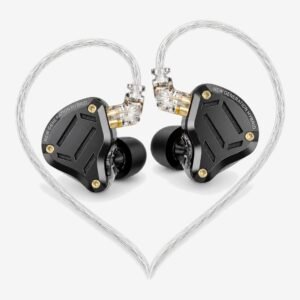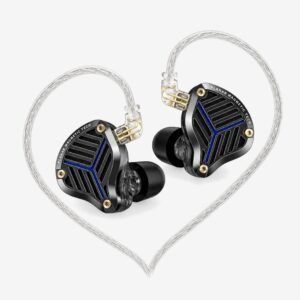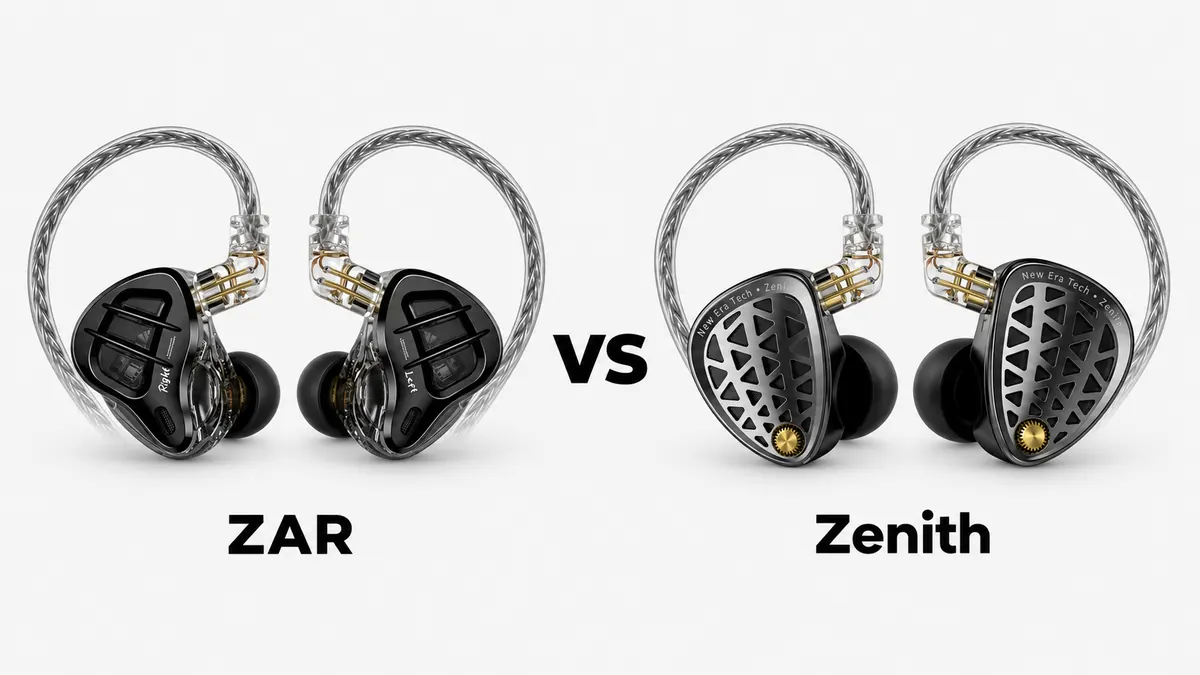
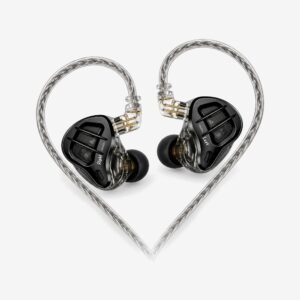
The KZ ZAR and the KZ Zenith are the two top models in KZ's wired range, and they represent two opposite ways of making an earphone. The ZAR splits the sound among eight drivers per side; the Zenith entrusts everything to a single new-generation dynamic driver. This comparison goes through how they differ, using the official specs.
In short
- Choose the ZAR if you want maximum instrument separation: 1 dynamic driver and 7 balanced armatures per side.
- Choose the Zenith if you prefer the coherence of a single driver, an all-metal shell and the option to adjust the bass with switches.
- Both use a Pin C connector and work with the same Bluetooth adapters.
Comparison table
| KZ ZAR | KZ Zenith | |
|---|---|---|
| Type | Hybrid | Dynamic |
| Drivers per side | 1 dynamic + 7 balanced armatures | 1 dynamic (Driver X) |
| Sound tuning | No | 4-position switch |
| Frequency response | 20–40000 Hz | 20–40000 Hz |
| Sensitivity | 109 ± 3 dB | 128 ± 2 dB |
| Impedance | 16.5 ± 3 Ω | 41 Ω |
| Shell | — | Full metal alloy |
| Cable | 8-core silver-plated, 120 cm | Silver-plated, 120 ± 5 cm |
| Connector | 0.75 mm 2-pin (Pin C) | 0.75 mm 2-pin (Pin C) |
| Microphone | Optional | Optional |
Data from the official KZ product pages (kz-audio.com).
Eight drivers versus one
In the ZAR, one dynamic driver handles the bass and seven balanced armatures share the mids and treble: 50024S units for the upper mids and 30019S for the highest treble, with an electronic crossover. The idea is for each driver to work only in the band where it performs best.
The Zenith does the opposite. It uses a single full-range dynamic driver, which KZ calls Driver X, with a larger voice coil and neodymium magnet than a standard 10 mm driver. With no crossover, all the sound comes from one diaphragm.
Neither approach is better by definition. Hybrids tend to stand out for detail and separation; a good dynamic, for a natural tone and punchy bass. It depends on what you want.
Sound tuning: only on the Zenith
The Zenith has a four-position switch on each earphone. According to KZ, position 1 raises the bass by 1 dB; 1 and 2, by 2 dB; 1, 2 and 3, by 3 dB; and with all four on, the whole range is boosted. You change it with the tool in the box. The ZAR has no switches: its tuning is fixed.
Do they need an amplifier?
No. The ZAR, at 16.5 Ω and 109 dB, is easily driven by a phone. The Zenith has higher impedance (41 Ω), but its stated sensitivity is very high, so it does not demand a powerful source either.
Price
The Zenith is the most expensive model in the catalog and the ZAR sits one step below. Current prices are on each product page:

Gaming & movie earphones, Hybrids, KZ, Musicians & stage
112,95 €Select options This product has multiple variants. The options may be chosen on the product page-
Hi-Fi & pro audio IEMs, Everyday earphones, Dynamic drivers, KZ
138,95 €Select options This product has multiple variants. The options may be chosen on the product page
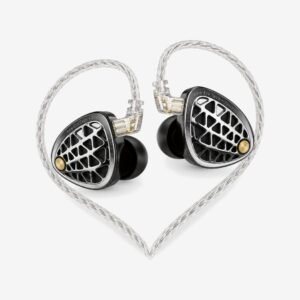
Which to choose
KZ ZAR
- You want detail and instrument separation.
- The 8-drivers-per-side setup appeals to you.
- You do not need to adjust the sound.
KZ Zenith
- You prefer the sound of a single dynamic driver.
- You want to set the bass to your taste.
- You value an all-metal shell.
Frequently asked questions
Which has more bass?
There are no official measurements comparing them. What can be verified is that the Zenith lets you raise the bass by up to 3 dB with its switches and the ZAR does not.
Are they compatible with Bluetooth adapters?
Yes. Both use Pin C: they work with the KZ AN01, the KZ AE01 and the KZ AZ09 in the Pin C version.
What does the Zenith include in the box?
According to KZ: three pairs of foam tips, three of silicone, the switch tool and a case.
Keep reading
Every KZ Componentes order comes with a 3-year warranty, 30-day returns and support from our team in Spain. Torn between models? Write to us and we will help you choose.
Your next step
Still torn between them?
Each model page has all its comparisons and who it suits. If you want us to make it easy, take the quiz.


 Español
 English