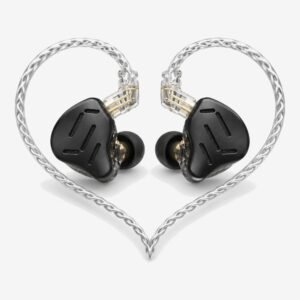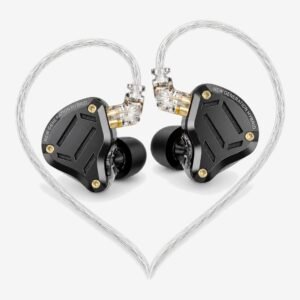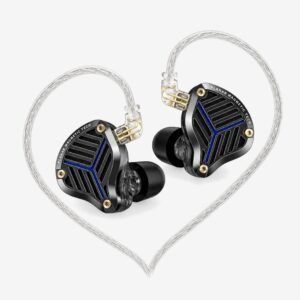
On any KZ product page you will see terms like “1DD + 4BA”, “13.2 mm planar” or “16 BA”. They all refer to the same thing: the driver, the part that turns the electrical signal into sound. There are several types and each has its own character.
In short
- Dynamic (DD): full-bodied bass and a warm sound. The most common.
- Balanced armature (BA): small and precise, strong in mids and treble.
- Hybrid: a dynamic driver for the bass and one or more BAs for the rest.
- Planar: flat diaphragm, low distortion and lots of detail.
Dynamic driver (DD)
It works like a miniature loudspeaker: a coil moves a diaphragm inside a magnet. It moves a lot of air, which is why it gives punchy bass and a natural sound. It is the simplest type and the one in entry-level KZ models, such as the KZ EDX Pro, but also in high-end models like the KZ Zenith. Some use two, like the KZ Castor. See dynamic-driver earphones.
Balanced armature (BA)
It is a tiny driver, originally made for hearing aids, in which a small metal reed vibrates between two magnets. It is very fast and precise in the mids and treble, but moves little air, so its bass has less punch. That is why several are usually fitted, each handling one band: the KZ AS16 Pro and the KZ AS16 Pro X have eight per side. See balanced-armature IEMs.
Hybrid (DD + BA)
It combines the two: the dynamic driver handles the bass and the armatures handle mids and treble. A crossover splits the signal. It is the most common formula in KZ's mid range: the KZ ZSN Pro X (1DD + 1BA), the KZ ZS10 Pro X (1DD + 4BA) or the KZ ZAR (1DD + 7BA). See hybrid IEMs.
Planar
It uses a very thin, flat diaphragm with the conductor spread across its whole surface, between magnets. It moves evenly, with little distortion and lots of resolution. It is usually less sensitive, so it benefits from more power. From KZ: KZ PR3 and KZ PRX. See planar IEMs.
How to read “1DD + 4BA”
The figure is the drivers per side: 1 dynamic driver and 4 balanced armatures in each earphone. When a product page says “10 drivers”, it usually counts both sides: 5 and 5.
Are more drivers better?
Not necessarily. More drivers let the work be shared out better, but what decides how an earphone sounds is how it is tuned. A good single-driver dynamic may please you more than an eight-driver hybrid. Choose by the kind of sound you want, not by the number.
| If you want… | Look at… |
|---|---|
| Punchy bass and a warm sound | Dynamics |
| Detail and instrument separation | Hybrids |
| Accurate vocals and instruments | Balanced armature |
| Maximum resolution | Planars |
Frequently asked questions
What is an electrostatic driver?
Some KZ models, such as the KZ ZEX Pro or the KZ ZES, add a small electrostatic driver for the treble alongside the dynamic.
Which type is best to start with?
A dynamic or a simple hybrid: they are easy to drive from a phone and pleasant with any music.
What is a crossover?
The circuit that sends each driver only the part of the sound it is meant to handle.
Keep reading
- Impedance and sensitivity: what you need for your earphones to sound good with a phone
- KZ PR3 vs KZ PRX: KZ's planar IEMs
- KZ AS16 Pro vs AS16 Pro X: differences and which to choose
- Which KZ earphones to buy: the complete guide by use and budget
- KZ AS16 Pro, AS16 Pro X, AM16 and AS24 Pro: a guide to KZ's all-BA models
Every KZ Componentes order comes with a 3-year warranty, 30-day returns and support from our team in Spain. Torn between models? Write to us and we will help you choose.
Your next step
Still not sure which to choose?
Five questions about what you need them for, your budget and how you will plug them in. We tell you which model fits and why.



 Español
 English