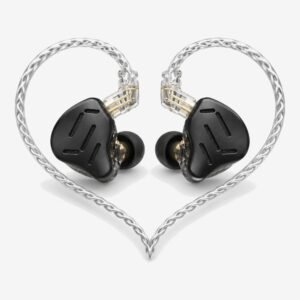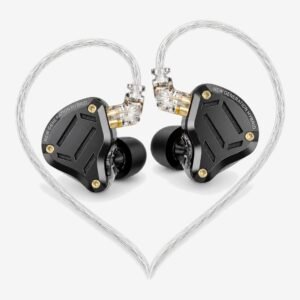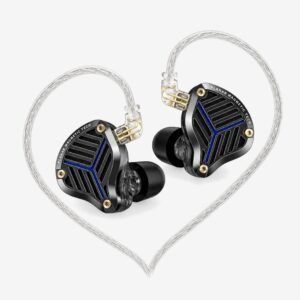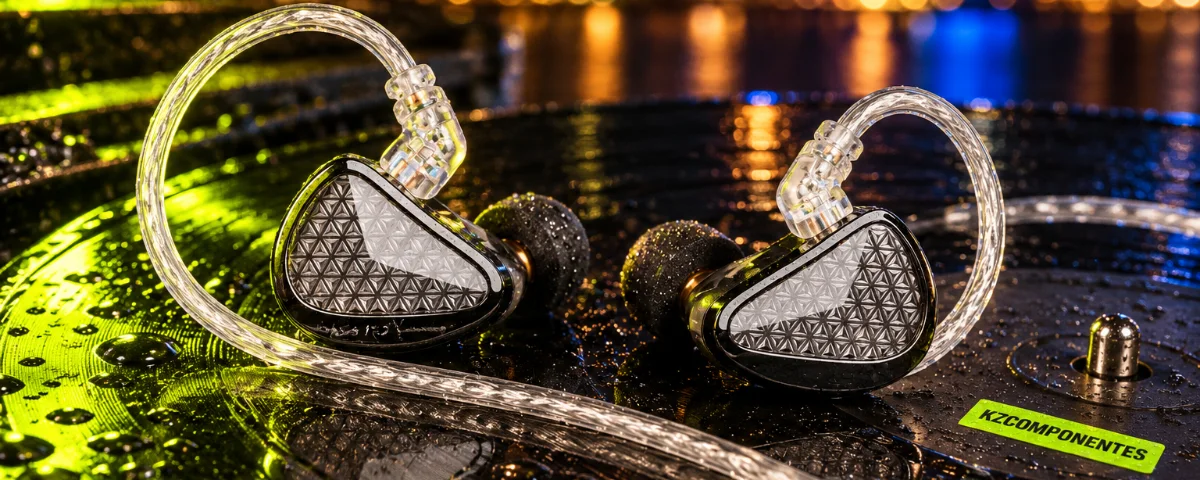
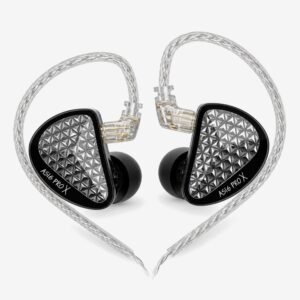
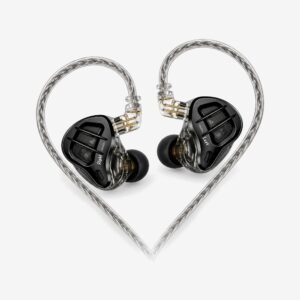
The KZ AS16 Pro X and the KZ ZAR are two of the most searched models in KZ's upper range, and on paper they look alike: eight drivers in each earpiece. The difference is in the approach. The AS16 Pro X uses balanced armatures only; the ZAR is a hybrid that adds a dynamic driver.
In short
- Both have 8 drivers per side: 8 balanced armatures in the AS16 Pro X; 1 dynamic driver and 7 armatures in the ZAR.
- In the ZAR the bass comes from a dynamic driver; in the AS16 Pro X, from a dedicated armature.
- The AS16 Pro X is more sensitive (116 dB vs 109 dB). The ZAR includes an 8-core silver-plated cable.
Comparison table
| KZ AS16 Pro X | KZ ZAR | |
|---|---|---|
| Type | Balanced armatures only | Hybrid |
| Drivers per side | 8 balanced armatures | 1 dynamic + 7 balanced armatures |
| Impedance | 19 Ω | 16.5 ± 3 Ω |
| Sensitivity | 116 ± 3 dB | 109 ± 3 dB |
| Frequency response | 20–40000 Hz | 20–40000 Hz |
| Cable | Flat, silver-plated, 120 ± 5 cm | 8-core silver-plated, 120 cm |
| Switches | No | No |
| Microphone | Optional | Optional |
| Connector | 0.75 mm 2-pin (Pin C) | 0.75 mm 2-pin (Pin C) |
Data from the official KZ product pages (kz-audio.com).
All balanced armature or hybrid
In the AS16 Pro X, each frequency band has its own armatures: four 31736 for the treble, one 30019 for the upper mids, two 29689 for the mids and one 22955 for the bass. There is no dynamic driver.
The ZAR splits the work differently: an in-house dynamic driver handles the bass and seven balanced armatures handle the mids and treble. KZ tunes it with a U-shaped curve, meaning bass and treble are slightly raised relative to the mids.
The practical difference is in the bass. A dynamic driver moves more air than an armature, which is why hybrids are usually chosen when you want more weight in that region. All-armature models are usually chosen for their definition in the mids and treble. The full explanation is in our guide to driver types.
Volume and source
Both have a low impedance and work with any phone. The AS16 Pro X is rated at 116 dB of sensitivity, a very high figure: it plays loud at low volume, and on noisy sources, such as some laptop outputs, it can reveal a faint background hiss. The ZAR, at 109 dB, is less prone to that.
Cable and versions
The AS16 Pro X comes with a flat silver-plated cable; the ZAR, with an 8-core braided silver-plated cable. Both are detachable 2-pin cables, and both models are sold in black with or without microphone. Neither has tuning switches.
Prices

Hi-Fi & pro audio IEMs, KZ, Multi-BA, Musicians & stage
95,95 €Select options This product has multiple variants. The options may be chosen on the product page-
Gaming & movie earphones, Hybrids, KZ, Musicians & stage
112,95 €Select options This product has multiple variants. The options may be chosen on the product page
Which to choose
KZ AS16 Pro X
- You want an all-armature model, with each band split between dedicated drivers.
- You want high sensitivity for low-power sources.
KZ ZAR
- You prefer the bass to come from a dynamic driver.
- You like a U-shaped tuning and want the 8-core cable included.
Frequently asked questions
How is the AS16 Pro X different from the AS16 Pro?
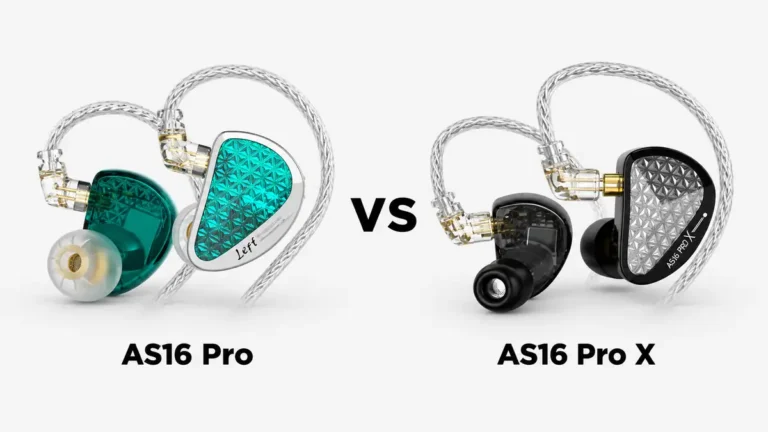
In the armature layout and the cable. We go through it in AS16 Pro vs AS16 Pro X.
And the ZAR vs the Zenith?
The Zenith uses a single dynamic driver with switches. See ZAR vs Zenith.
Do they work with a Bluetooth adapter?
Yes. Both use Pin C: KZ AN01, KZ AE01 and KZ AZ09 in the Pin C version.
Do they need an amplifier?
No. Given their impedance and sensitivity, both work straight from a phone.
Keep reading
Every KZ Componentes order comes with a 3-year warranty, 30-day returns and support from our team in Spain. Torn between models? Write to us and we will help you choose.
Your next step
Still torn between them?
Each model page has all its comparisons and who it suits. If you want us to make it easy, take the quiz.


 Español
 English