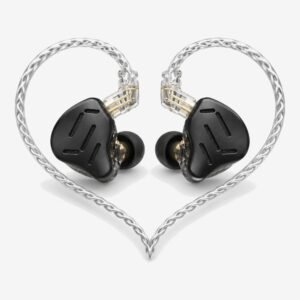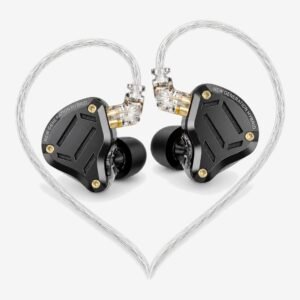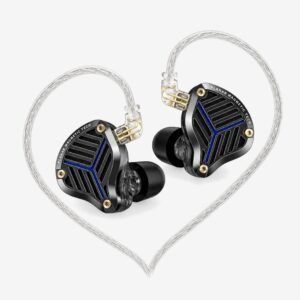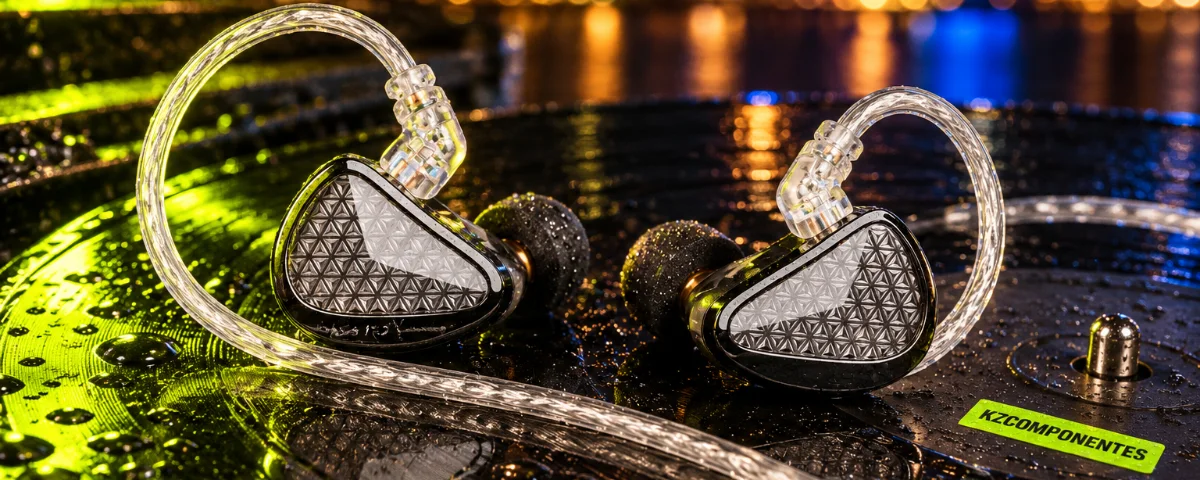
The terms you see on in-ear spec sheets, explained in one or two sentences and linked to the guide where we cover them in depth. Each model’s data comes from KZ’s official spec sheets (kz-audio.com).
Passive isolation · Ear tips · Headphone amplifier · Balanced armature (BA) · Detachable cable · Active noise cancelling (ANC) · Click · 2-pin connector · Bluetooth codec · DAC · Driver · Dynamic driver (DD) · Planar driver · Sound signature · Harman (curve) · Hybrid · Impedance · Tuning switches · 3.5 mm and 4.4 mm jack · Latency · Monitor mix · MMCX · In-ear monitors (IEM) · IEM bodypack · Pin B and Pin C · Frequency response · Sensitivity · TWS · Ways
- Passive isolation
- The outside noise an in-ear blocks simply by sealing the ear canal with the ear tip. No electronics involved: it depends on how well they fit. It is what lets you hear yourself in the rehearsal room without turning the volume up as much. More in how to wear in-ear earphones properly.
- Ear tips
- The silicone or foam tips that go on the earphone nozzle. They come in sizes (S, M, L) and they create the seal: if the size isn’t yours, you lose bass and isolation.
- Headphone amplifier
- A device that gives headphones more power. In-ears are usually easy to drive and work fine with a phone, a mixing desk or a bodypack without a separate amp. More in impedance and sensitivity.
- Balanced armature (BA)
- A very small driver in which a reed moves between magnets. It is efficient and precise, but each armature covers one part of the sound well, which is why all-armature models use several, split across ways. More in driver types.
- Detachable cable
- A cable that detaches from the earphone. If it breaks or you want a different one (with a mic, USB-C, longer), you replace the cable, not the earphones. More in cables for KZ earphones.
- Active noise cancelling (ANC)
- A system with microphones and electronics that creates an inverted signal to cancel noise. It is a feature of some wireless earphones; wired in-ears isolate passively, through the seal.
- Click
- A metronome track the drummer (or the whole band) hears in their in-ears to play in time, especially with backing tracks or sequences. More in IEMs for drummers.
- 2-pin connector
- The most common detachable cable connector on in-ears: two thin pins that plug into the earphone. Almost every wired KZ uses it. More in Pin B or Pin C.
- Bluetooth codec
- The format used to compress and send audio over Bluetooth (SBC, AAC, aptX, LDAC…). Both devices must share the codec; otherwise the basic one is used.
- DAC
- Digital-to-analogue converter: it turns digital audio into the signal that drives the earphones. A phone without a jack needs one, usually built into a USB-C to jack adapter. More in wired earphones on a phone without a jack.
- Driver
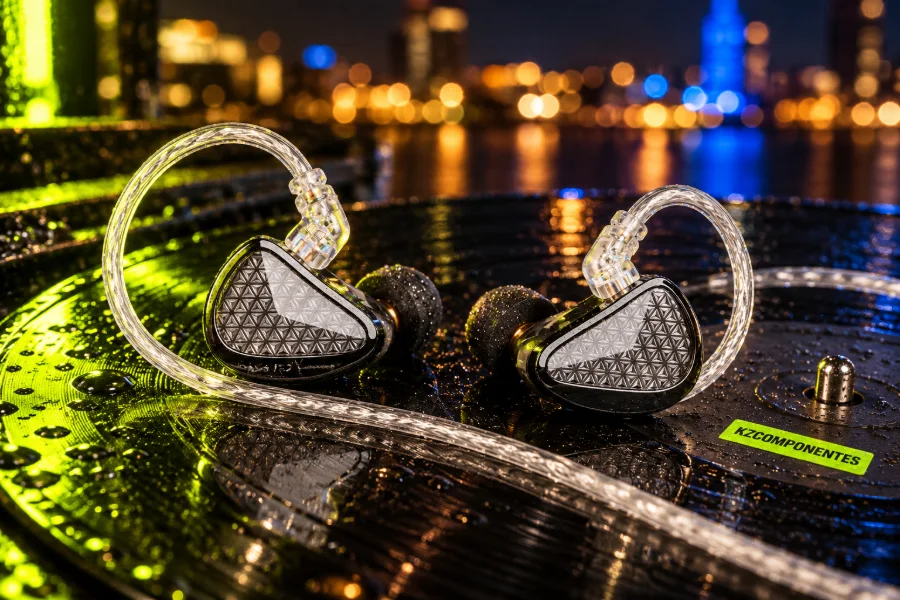
- The part that turns the electrical signal into sound. An earphone can have one or several, of different types (dynamic, balanced armature, planar).
- Dynamic driver (DD)
- A driver with a diaphragm moved by a coil inside a magnet, like a miniature speaker. It is the most common type and usually gives the most punch in the bass. More in driver types.
- Planar driver
- A driver with a very thin diaphragm carrying a printed circuit, placed between magnets. It moves more evenly than a dynamic diaphragm. More in KZ’s planar models.
- Sound signature
- How an earphone balances bass, mids and treble: “V-shaped” (boosted bass and treble), neutral, warm… The versions of some KZ models (Improved Bass, Balanced, Harman) change that signature.
- Harman (curve)
- A reference curve from Harman’s research into which response most listeners prefer. When a KZ comes in a “Harman” version, KZ says it is tuned to that reference.
- Hybrid
- An earphone that combines driver types, usually one or more dynamic drivers for bass and balanced armatures for mids and treble. More in driver types.
- Impedance
- The resistance the earphone presents to the signal, in ohms (Ω). With low impedance, like most in-ears, a phone or a bodypack drives them without trouble. More in impedance and sensitivity.
- Tuning switches
- Small switches on the shell of some KZ models that change the sound (more or less bass or treble). More in KZ tuning switches.
- 3.5 mm and 4.4 mm jack
- The 3.5 mm jack is the classic headphone plug. The 4.4 mm one is the balanced version used by some DACs and players; it needs a cable with that plug.
- Latency
- The delay between a sound happening and you hearing it. Bluetooth adds a delay you notice when playing, which is why live monitoring uses a cable or a wireless IEM system, not Bluetooth.
- Monitor mix
- What each musician hears in their in-ears: a send from the desk with their instrument, the vocals, the click… adjusted to taste. More in in-ear monitors for live use.
- MMCX
- Another detachable cable connector, round and able to rotate. KZ mainly uses 2-pin, so an MMCX cable won’t fit most KZ models.
- In-ear monitors (IEM)
- Earphones that sit inside the ear canal, used by musicians to hear themselves on stage instead of floor wedges.
- IEM bodypack
- The receiver a musician wears on their belt: it receives their monitor mix (wired or wireless) and has its own volume. The in-ears plug into the bodypack.
- Pin B and Pin C
- The two versions of the 2-pin connector KZ uses. They differ in the shape of the connector, so it is worth knowing which one your KZ has before buying a cable or an adapter. More in Pin B or Pin C.
- Frequency response
- The range of sounds, from bass to treble, an earphone reproduces, in hertz (for example, 20 Hz–20 kHz). It tells you the range, not how it sounds within it.
- Sensitivity
- How loud an earphone plays with a given power (dB/mW). The higher it is, the more volume it gets from a phone or a bodypack. More in impedance and sensitivity.
- TWS
- True Wireless Stereo: Bluetooth earphones with no cable at all, not even between the two buds. More in TWS or adapter.
- Ways
- How many parts the sound is split into across an earphone’s drivers. In 3-way in-ears, some drivers handle the bass, others the mids and others the treble.
Missing a term or something unclear? Email contacto@kzcomponentes.com and we’ll add it.
Your next step
Still not sure which to choose?
Five questions about what you need them for, your budget and how you will plug them in. We tell you which model fits and why.

 Español
 English